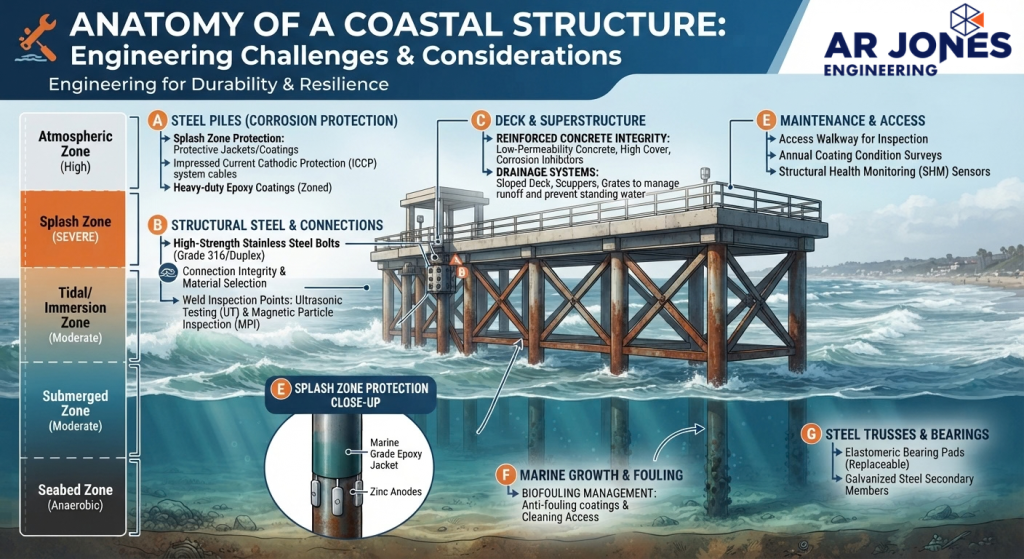
Steel is strong, durable and widely used in industrial and coastal infrastructure. But when steel is exposed to the coastal environment, it faces a persistent enemy: corrosion.
Salt in the air, moisture and changing weather conditions create an environment where corrosion can develop and gradually weaken unprotected steel. Salt particles can settle on steel surfaces and attract moisture, creating the conditions needed for corrosion to occur. In coastal areas, even structures that are not directly exposed to seawater can be affected by salt-laden air.
This is why engineering for coastal environments requires more than simply selecting a strong material. Protection needs to be considered from the design and fabrication stages.
Four factors matter:
- Material selection: The environment in which a structure will operate must be considered when selecting materials and protection systems.
- Surface preparation: Proper preparation before applying protective coatings is critical to achieving effective and long-lasting protection.
- Protective coatings: Appropriate coating systems can create a barrier between the steel and the corrosive coastal environment.
- Inspection and maintenance: Even well-protected steel requires regular inspection. Identifying coating damage, rust or other deterioration early can prevent more serious problems later.
For coastal engineering, durability is not simply about how strong a structure is when it is installed. It is about how well it continues to perform years after installation.
At AR Jones Engineering, we understand that engineering solutions must be designed with their environment in mind. In coastal and industrial settings, precision, protection and preventative maintenance all play a role in extending the life of steel structures.
Because when you build near the ocean, you are not just engineering for today — you are engineering to withstand the elements.